
Early settlement
Ur developed in the alluvial and marshy environment of southern Mesopotamia. The landscape was not the barren desert seen today: waterways, reed beds, canals and shifting river courses structured settlement and movement.
 A feature of← The Abrahamic Movement in IraqUR · Digital Exhibit
Ancient Mesopotamia · Southern Iraq · c. 5th millennium BCE–late antiquity
A city of kings, merchants, scribes, moon-god priests—and one of archaeology’s most consequential windows into early urban civilization.
 PRESENTED BYThe Virtual Embassy of Iraq in IsraelIndependent Civic Diplomacy Initiative
Photo: Michael Lubinski, CC BY-SA 2.0, via Wikimedia Commons
Scroll to explore↓Why Ur matters
Ur was one of the great cities of southern Mesopotamia. Its temples, royal tombs, houses, tablets, workshops and imported luxuries reveal not just rulers and wars, but contracts, schooling, inheritance, worship, food, labor and family life.
The story of Ur brings together archaeology, ancient texts, religious tradition and living memory—including the city’s place in the story of Abraham.
Choose a path
Jump into the city through the story that interests you. Swipe or scroll the collections instead of reading one endless page.
01 · Deep history
Dates in early Mesopotamian chronology can vary by scholarly convention. The timeline below uses common approximate dates and emphasizes broad historical phases rather than false precision.
Ur developed in the alluvial and marshy environment of southern Mesopotamia. The landscape was not the barren desert seen today: waterways, reed beds, canals and shifting river courses structured settlement and movement.
Ur became a powerful city-state. The Royal Cemetery belongs largely to this era, preserving elite burials, music, vehicles, weapons, jewelry and the object called the Standard of Ur.
Southern Mesopotamian cities were drawn into larger political systems. Ur passed through periods of domination associated with Akkadian and Gutian power before its own resurgence.
Ur-Nammu established a kingdom centered on Ur, launched major building programs and is associated with one of the earliest surviving law collections.
Under Shulgi, administration expanded dramatically. Tens of thousands of cuneiform tablets document taxation, labor, livestock, fields, transport and state institutions.
The dynasty ended amid political fragmentation, military pressure and economic stress. Mesopotamian literary tradition later memorialized the catastrophe in laments over Ur.
Ur did not disappear after Ur III. Rulers of Isin, Larsa, Babylon and later empires restored temples and maintained the cult of the moon god. The city remained religiously significant for centuries.
The Neo-Babylonian king Nabonidus restored ancient cult buildings at Ur and installed his daughter as high priestess of the moon god—part of a broader program connecting his reign to Mesopotamia’s deep past.
Environmental change, altered waterways and shifting political-economic networks contributed to Ur’s decline. Occupation dwindled and the monumental core became a ruin mound.
Leonard Woolley directed major excavations sponsored by the British Museum and the University of Pennsylvania Museum, uncovering the Royal Cemetery, domestic quarters and the ziggurat precinct.
Ur became one of the archaeological components of The Ahwar of Southern Iraq, a mixed World Heritage property linking ancient cities with their historic wetland landscape.
Pope Francis met religious representatives on the Plain of Ur and invoked Abraham as a shared figure of faith and fraternity, reinforcing the site’s modern symbolic role.
02 · The city
Ur was not a static monument. It was a living urban organism shaped by temples, households, bureaucracy, river transport, agriculture and long-distance exchange.
The ziggurat and temple complex formed the ceremonial core. The moon god Nanna—later widely known as Sîn—was Ur’s principal divine patron.
Excavated houses reveal courtyards, rooms for work and storage, drains, hearths, burials beneath floors and tablets kept by families and professionals.
Palaces, temples and state institutions mobilized labor and recorded commodities in cuneiform: grain, wool, livestock, land, rations, boats and personnel.
Waterways connected Ur to fields, marshes, neighboring cities and the Gulf. Ancient southern Mesopotamian urbanism depended on hydraulic landscapes.
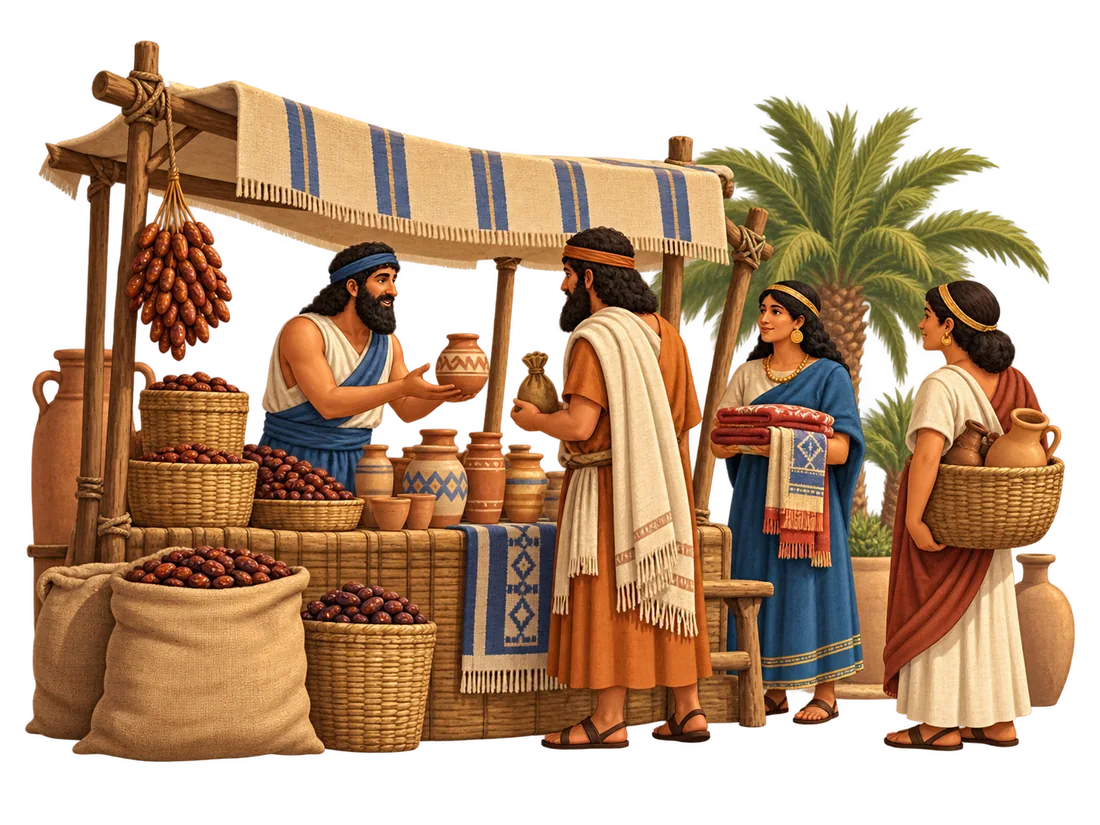
Ur’s elite goods include materials not native to southern Iraq: lapis lazuli, metals, timber, shell and stone—evidence of exchange reaching far beyond Mesopotamia.
Metalworkers, stonecutters, potters, textile workers and seal cutters transformed imported and local materials into objects of ritual, status and daily use.
A day in Ur
Most evidence for daily life comes from ordinary spaces and documents. A resident might negotiate a loan, buy land, inherit a house, deliver textiles, study tablet signs, worship a household deity, or bring goods by boat. Families were economic units as well as social ones.
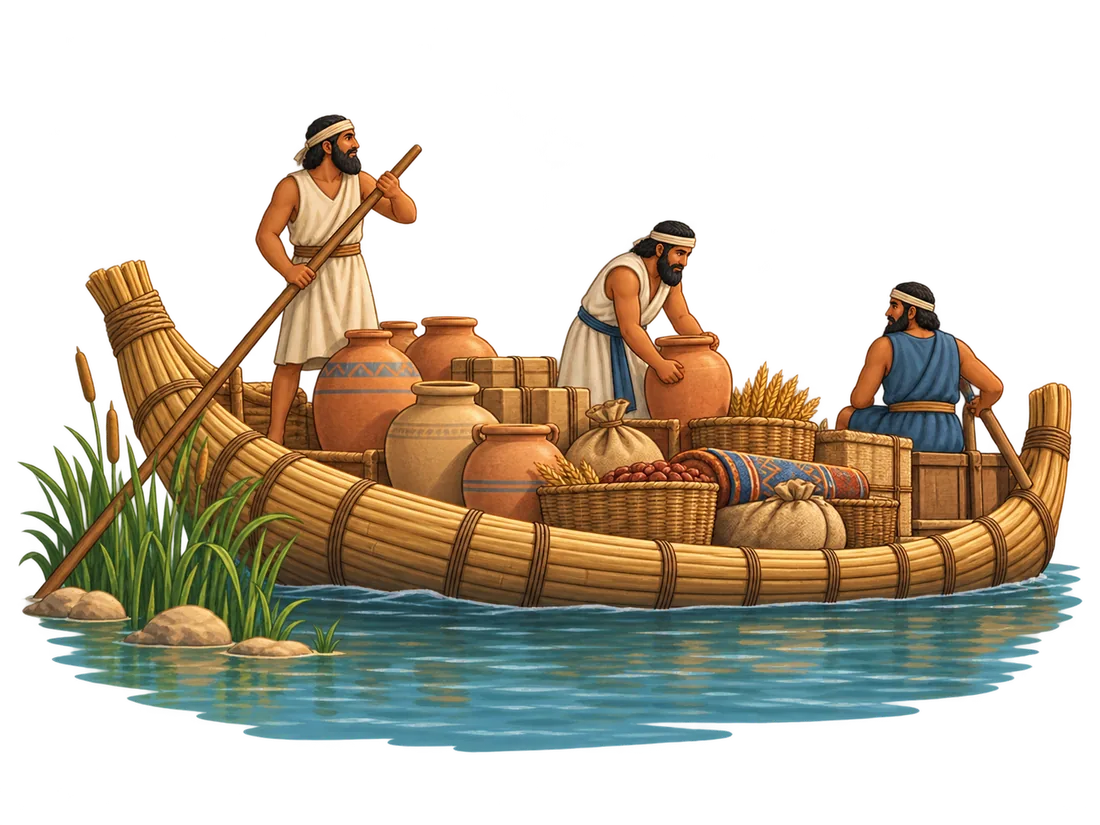
Canals, marsh channels and rivers moved people, food and trade goods through southern Mesopotamia.

Great Ziggurat of Ur. Michael Lubinski, CC BY-SA 2.0, via Wikimedia Commons.
03 · Monument
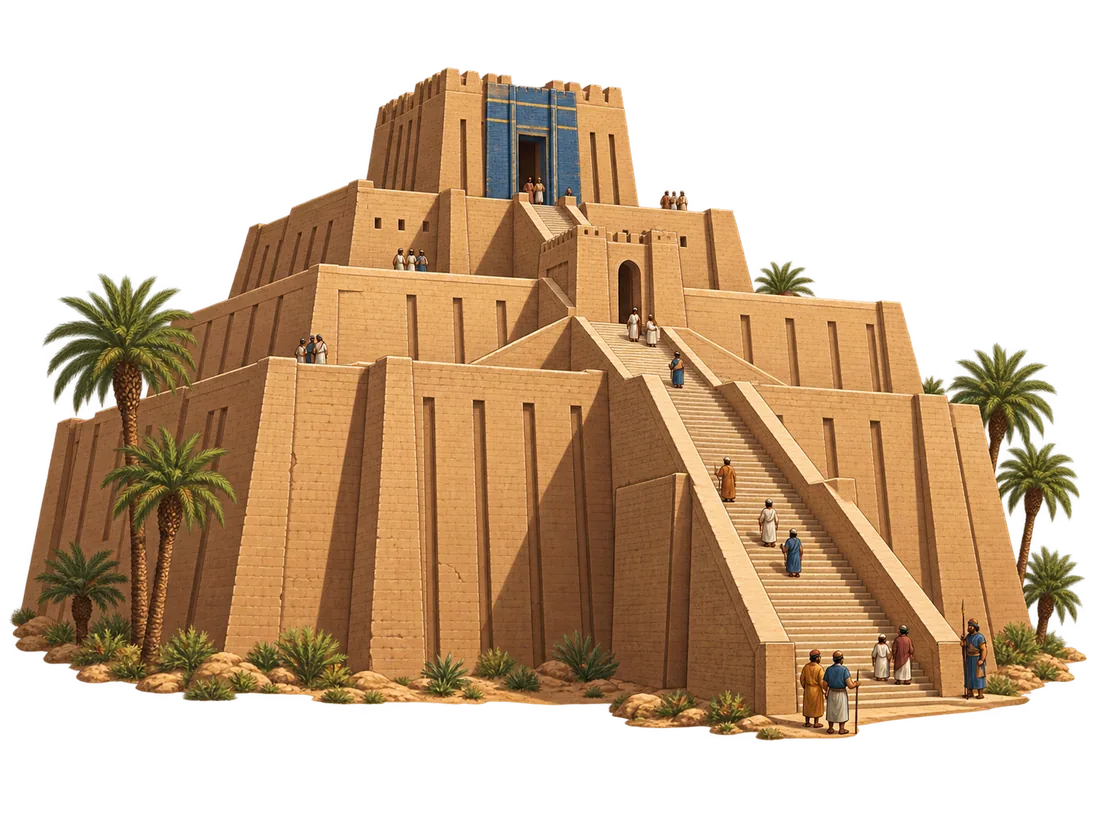
Built under Ur-Nammu around 2100 BCE and dedicated to Nanna, the ziggurat translated political and religious power into architecture.
The surviving mass is largely mud brick with baked-brick facing in key areas. Ancient ziggurats were stepped temple platforms, not tombs and not pyramids in the Egyptian sense. Their uppermost sacred structures do not survive at Ur.
04 · Archaeology
Woolley excavated more than a thousand graves. A small group stood out for extraordinary architecture and grave goods, inspiring the label “royal tombs.” Their interpretation continues to evolve.

Object focus
A small trapezoidal box-like object inlaid with shell, red limestone and lapis lazuli. One long face depicts organized violence, prisoners and a larger-than-life ruler; the other depicts procession, provisions and elite feasting.
Its original function is unknown. “Standard” is a modern label, not an ancient identification.
British Museum record ↗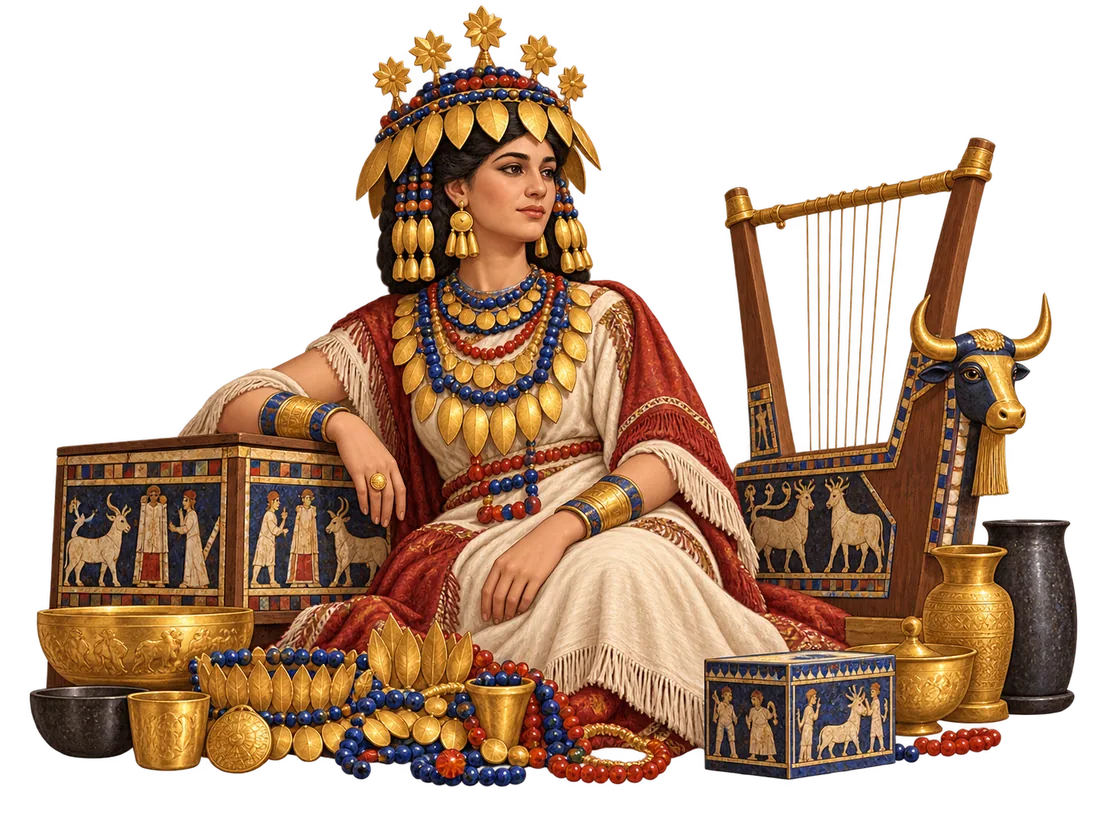
A richly furnished tomb contained the cylinder seal of Puabi, whose title is commonly rendered “queen” or “lady.” Her jewelry, vessels and attendants made the burial one of Ur’s most famous discoveries.
Some elite graves contained many human bodies. Woolley proposed ceremonial sacrifice. Later bioarchaeological work has revisited how those individuals died, were treated and were deposited.
Lyres, decorated sound boxes and gaming boards show that elite ceremonial life included music, performance and play. The Royal Game of Ur became one of archaeology’s best-known ancient board games.
05 · State power
Ur III was more than a “golden age.” It was a highly organized state whose surviving paperwork gives historians an unusually granular view of institutions and labor.
Founder of the dynasty; monumental builder; associated with a surviving law collection framed around royal justice.
Long-reigning ruler who expanded administration, royal ideology, road networks and state control.
Maintained the imperial system after Shulgi while confronting the structural costs of a large territorial state.
Remembered in administrative and royal texts, including major defensive projects on the kingdom’s frontiers.
Last king of the dynasty; his reign saw territorial loss, shortages and the eventual fall of Ur.
Ur III documents record deliveries, labor teams, livestock, travel, fields, cult offerings and institutional accounting. Their importance lies less in any single tablet than in the enormous administrative ecosystem they preserve.
06 · Religion & knowledge
Mesopotamian religion was embedded in civic life. Temples owned land, employed workers, received offerings and participated in economic administration.
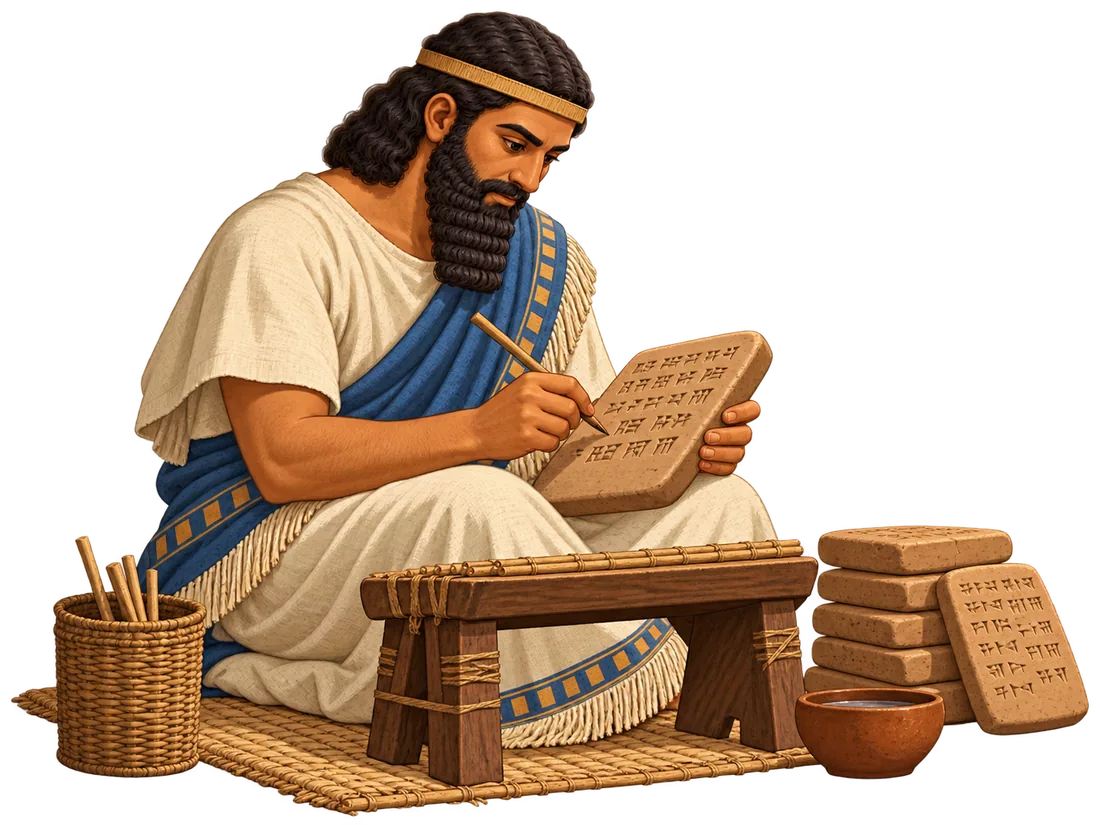
The moon god was Ur’s principal deity. His cult connected lunar cycles, calendrical time, divine kingship and the city’s sacred identity.
Ningal, “Great Lady,” was Nanna’s consort and had her own cultic institutions within Ur’s religious landscape.
High-status priestly offices connected temples with royal power. Royal daughters could hold major cultic posts, strengthening political and sacred ties.
Tablets from Ur illuminate education, lexical learning, accounting and legal practice. Writing was a specialized skill with enormous administrative value.
07 · Ur & Abraham
Ur stands at the heart of Abrahamic memory as the city from which Abram’s family set out toward Harran and Canaan in the biblical narrative.
Tell el-Muqayyar in southern Iraq is ancient Ur, a major Sumerian and Mesopotamian city with a long history and a major moon-god cult.
Genesis and Nehemiah refer to Ur Kasdim, commonly translated “Ur of the Chaldeans/Chaldees,” in the ancestral story of Abram/Abraham and Terah’s family.
Jewish, Christian and Islamic traditions place Abraham at the heart of a shared religious inheritance, and Ur has become one of the principal places associated with that memory.
The archaeological site of Ur in southern Iraq is also a modern place of Abrahamic encounter. The 2021 interreligious meeting on the Plain of Ur brought this shared memory into contemporary dialogue.
Abrahamic memory
The biblical story begins with Terah’s household leaving Ur for Harran and continues with Abram’s journey from Harran toward Canaan. Ur therefore forms the opening landscape of one of the foundational journeys in Abrahamic memory.
For visitors today, the ancient city joins Iraq’s Mesopotamian heritage with a living religious memory shared across Judaism, Christianity and Islam.
Genesis itinerary
Genesis 11–12 presents a two-stage journey: Terah’s household departs Ur and settles at Harran; Abram later leaves Harran for Canaan. From southern Mesopotamia, the route north toward Harran follows the great riverine and overland corridors that connected the cities of the ancient Near East.
The map follows the sequence Ur → Harran → Canaan described in Genesis 11–12.
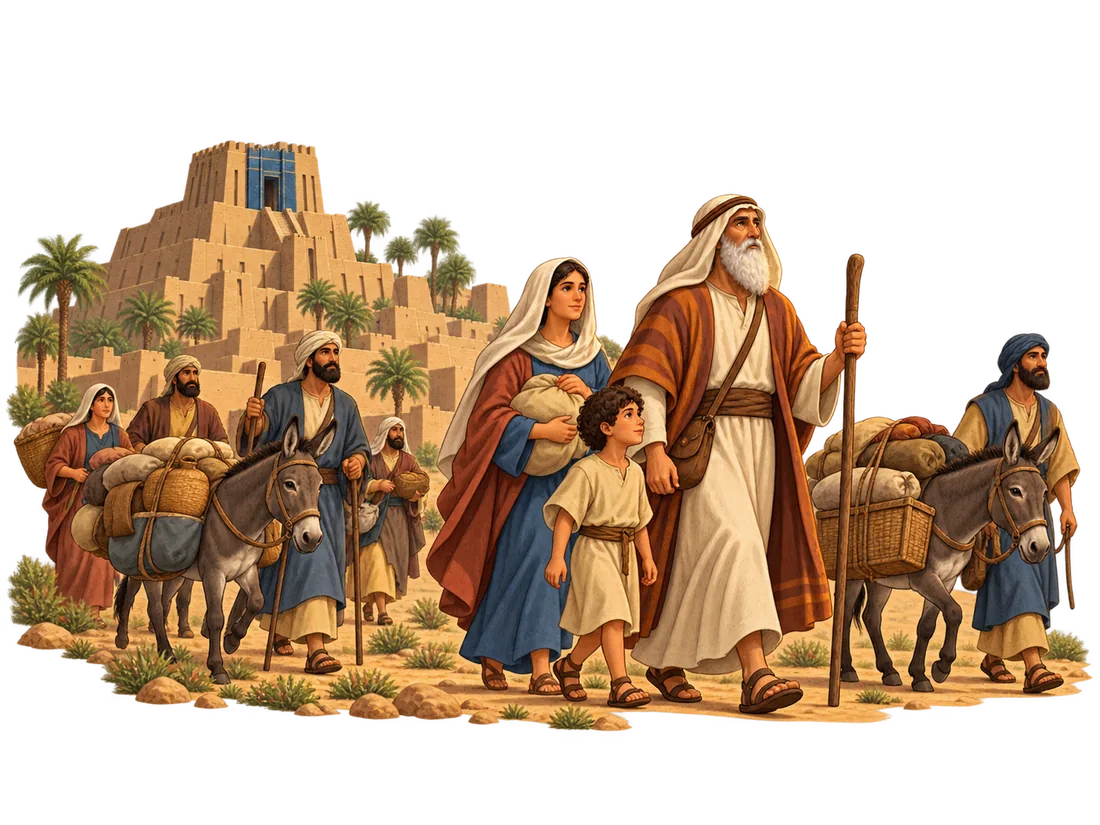
Abraham is the patriarch with whom covenant, ancestry and the promise of land and descendants are deeply associated in Genesis and later Jewish tradition.
Christian texts interpret Abraham as a paradigmatic figure of faith. The 2021 papal visit to Iraq used Ur as a modern interreligious symbol of shared origins and fraternity.
Ibrāhīm is a major prophet in the Qur’an and Islamic tradition, honored as a model of faith and devotion to God. Ur offers a powerful Iraqi setting for reflecting on his legacy and the common Abrahamic inheritance.
Ur brings together Iraq’s ancient Mesopotamian past and the enduring memory of Abraham. The site has become a place where Jews, Christians and Muslims can encounter a story that belongs to the shared Abrahamic heritage of the region.
08 · Legacy
Ur’s legacy sits at the intersection of archaeology, Iraqi heritage, the history of cities, museum collections and religious memory.
Ur helps scholars study how dense settlements, institutions, record-keeping and monumental religion operated in early urban societies.
UNESCO’s Ahwar inscription emphasizes that Ur’s original environmental setting was marshy and riverine, not simply desert.
The site belongs first to Iraq’s cultural landscape and history, while its artifacts and archives are dispersed among institutions in Iraq, Britain and the United States.
Ur has become a powerful setting for conversations about Judaism, Christianity, Islam and shared ethical responsibility through the memory of Abraham.
09 · A–Z explorer
A compact reference index for the people, places, objects and ideas encountered across the site.
Biblical patriarch associated with “Ur of the Chaldeans” and central to Jewish, Christian and Islamic memory.
A staple crop and accounting commodity central to Mesopotamian subsistence, wages and institutional economy.
Wedge-shaped writing impressed on clay; Ur’s archives preserve administrative, legal, literary and educational texts.
The Third Dynasty of Ur created a major territorial state centered on the city around 2112–2004 BCE.
A prestigious priestly office linked to the moon-god cult and, at times, held by royal daughters.
Ur grew on the dynamic alluvial plain of the Tigris-Euphrates system amid shifting waterways and marshes.
A famous ancient race-game board type found in royal graves and later attested elsewhere in the Near East.
Northern Mesopotamian city central to Genesis 11–12 and, like Ur, an important center of moon-god worship.
Last king of Ur III; his reign ended amid fragmentation and the fall of the dynasty.
Gold, lapis lazuli, carnelian and other materials from royal graves reveal elite display and long-distance exchange.
Royal ideology linked military success, justice, temple building and divine favor.
Prestigious blue stone imported from far to the east, demonstrating Ur’s participation in interregional trade.
Nanna/Sîn, patron deity of Ur and focus of the city’s monumental sacred precinct.
Sumerian name of Ur’s moon god; Sîn became the common Akkadian name.
Food, drink, animals and goods supplied to temples and deities through organized cultic economies.
Elite woman buried in the Royal Cemetery, known from her inscribed cylinder seal and extraordinary grave goods.
A convenient modern translation for Puabi’s title nin, though ancient titles do not always map neatly onto modern categories.
Early Dynastic burial ground excavated by Woolley, famous for elite tombs and spectacular objects.
Second ruler of Ur III and architect of an intensely documented imperial administrative system.
Clay documents that preserve the routine paperwork and intellectual culture of Mesopotamian life.
Founder of Ur III, builder of the ziggurat and royal lawgiver in Mesopotamian tradition.
Wheeled vehicles appear in elite burials and visual art, including the Standard of Ur.
Leonard Woolley directed the famous 1920s–30s excavations that transformed modern knowledge of Ur.
Ur’s imported materials testify to far-reaching networks connecting Mesopotamia with Iran, the Gulf and beyond.
Mesopotamian administrations often identified years by named royal events, creating chronological frameworks for documents.
Stepped sacred platform built for the moon god and the most visually dominant surviving monument at Ur.
10 · Sources & references
The sources below bring together archaeology, museum collections, ancient texts and modern heritage records used throughout the exhibit.
Established means supported by archaeological context or broad specialist consensus. Text attested means stated in ancient written sources. Tradition identifies religious or historical memory. Interpretive context marks subjects explored through modern scholarship, heritage practice and public memory.