What changed?
Formal relations opened pathways for embassies, official dialogue, travel, trade, tourism, technology, investment and other bilateral cooperation.

Learn what the Abraham Accords are, which countries entered the framework, what happened in 2020, what normalization changes in practice, what the agreements do not settle, and why Iraq is a separate legal and political question.

The core 2020–2021 normalization tracks involved Israel, the United Arab Emirates, Bahrain, Morocco and Sudan, with the United States playing a central brokering role. The legal instruments were not identical: the UAE signed a full normalization treaty; Bahrain a peace and diplomatic-relations declaration; Morocco a trilateral joint declaration; and Sudan signed the Abraham Accords Declaration while full bilateral implementation later stalled amid political upheaval and war. In November 2025, Kazakhstan announced accession to the Abraham Accords. Kazakhstan is a different case because it had already maintained diplomatic relations with Israel since 1992.
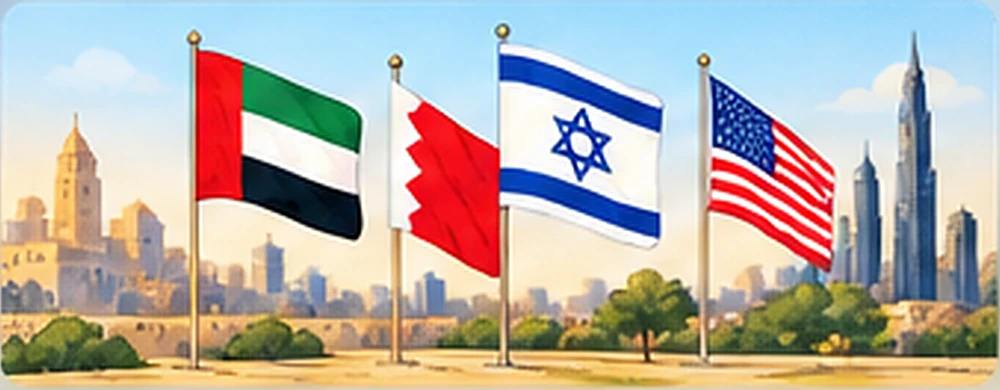
Formal relations opened pathways for embassies, official dialogue, travel, trade, tourism, technology, investment and other bilateral cooperation.
The Accords did not by themselves resolve the Israeli–Palestinian conflict, settle every regional dispute or make every Arab or Muslim-majority state a participant.
No. Iraq is not a signatory and Iraqi Law No. 1 of 2022 criminalizes normalization with Israel.
Follow announcements, signatures and later accession separately; they are different diplomatic acts.
The United States, Israel and the UAE announced an agreement to move toward full normalization.
Bahrain and Israel announced that they would establish full diplomatic relations.
Israel and the UAE signed a treaty of peace, diplomatic relations and full normalization. Israel and Bahrain signed a declaration of peace and diplomatic relations, alongside the Abraham Accords Declaration.
Sudan and Israel announced agreement to normalize relations. Later Sudanese political instability and war complicated implementation.
Morocco, Israel and the United States signed a joint declaration in Rabat restoring official contacts and expanding bilateral cooperation.
Sudan joined the declaration, while full bilateral normalization remained unfinished.
Kazakhstan formally announced accession to the Abraham Accords. Because Kazakhstan and Israel had diplomatic relations since 1992, this represented participation in the framework rather than first-time normalization.
The framework is not one identical treaty copied across countries. Select a participant to see the legal or diplomatic path.
Israel and the UAE signed a treaty of peace, diplomatic relations and full normalization. The treaty and annex contemplated cooperation in finance, aviation, trade, health, science, tourism and other fields.
Israel and Bahrain signed a declaration opening diplomatic relations and committing to peaceful, friendly and cooperative relations.
The United States, Morocco and Israel signed a joint declaration that called for full official contacts, direct flights, reopened liaison offices and cooperation across multiple sectors.
Sudan announced normalization with Israel in October 2020 and signed the Abraham Accords Declaration in January 2021. Political upheaval and the subsequent war prevented a fully implemented bilateral normalization process.
Kazakhstan announced accession to the Abraham Accords while already maintaining diplomatic relations with Israel since April 1992. Its role therefore illustrates how the framework expanded beyond the original first-time normalization cases.
Supporters describe the Accords as a shift from non-recognition toward practical diplomacy, economic integration and regional cooperation. U.S. officials have highlighted trade, travel, security cooperation and interfaith initiatives as outcomes of normalization.
Iraq is not a signatory to the Abraham Accords and does not currently have diplomatic relations with Israel. The subject “Iraq and the Abraham Accords” is therefore a debate about possible future policy, civic dialogue and regional change—not a description of current Iraqi membership.
Iraq enacted Law No. 1 of 2022 criminalizing normalization with Israel. Any discussion of Iraqi participation must distinguish civic advocacy from the present legal position of the Iraqi state and should consult current official Iraqi legal sources because laws and political conditions can change.
UAE and Bahrain were the central September 2020 White House signing cases.
Morocco restored and expanded official ties through a joint declaration; Sudan signed the declaration but implementation remained incomplete.
Kazakhstan announced accession in 2025 despite already having diplomatic relations with Israel since 1992.
Other states can be discussed as possible future participants, but discussion or negotiation is not membership. As of this page’s 29 August 2026 update, Saudi Arabia is not a signatory.


Open each card, answer in your own words first, then reveal the explanation.
Use primary documents for the wording of treaties and declarations, then compare reporting and analysis for consequences and competing interpretations.
Place the Accords inside the wider history of diplomacy, Iraq–Israel relations and Iraqi Jewish heritage.